
Looking for the Lost

Ukraine March, 2022
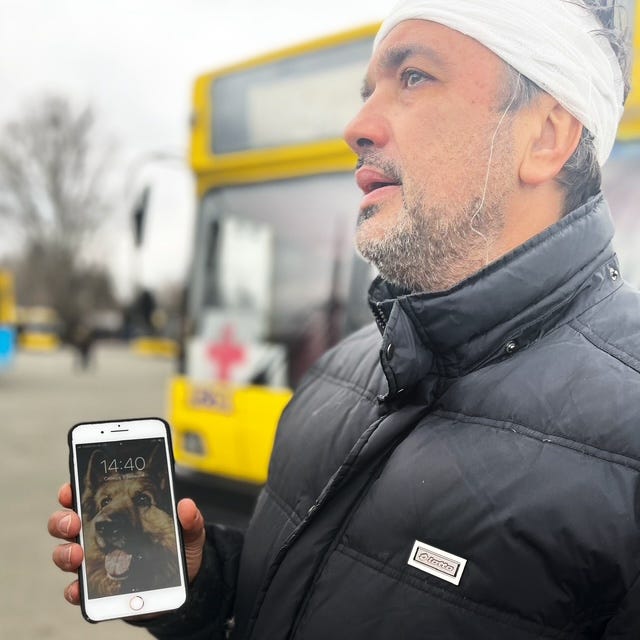
In a muddy open field on the outskirts of Kyiv, on another snowy afternoon, a man wanders aimlessly outside a newly established evacuation medical tent. Blood-stained bandages wrap around his head and left arm. A small trail of blood follows him across the frozen ground.
As I approach, his glazed eyes dissolve into sobs. He pulls up a photograph of a smiling German Shepherd on his phone and tells me, through tears, that Russian soldiers shot his beloved Ralph “for fun” as they withdrew from his newly occupied hometown of Bucha.
Inside the tent, a rare pocket of warmth amid the freeze, a toddler unloads and reloads small crates of strawberry yogurt to entertain herself. Nearby, her mother methodically packs and unpacks their single suitcase, the only belongings they managed to bring in their frantic dash for safety.
Not far away, another mother, Maria, sits cross-legged on the floor, cradling a tiny newborn wrapped in fleece blankets, sleeping soundly through it all. Artillery thuds through the pale afternoon sky, growing louder, yet Maria doesn’t flinch. Her baby boy — Mark, I understood — was born just days into the full-scale invasion in a Kyiv suburb called Vorzel, under a storm of bombs and gunfire.
Maria presses him closer, a fleeting smile crossing her face, one that falls quickly when I cautiously ask if this is her first child.
“I had to leave my other two behind when I went to the hospital to give birth,” she says, her voice breaking. “They’re with relatives in Bucha — under Russian occupation.”
The communication lines are down. Maria can no longer reach them. Tears stream down her face as she murmurs, “I don’t know if they are okay, or when I’ll see them again.” Then, more firmly, as if willing it into truth: “Soon. Soon.”
Maria has no idea where she will go from here. She has just arrived at this ad hoc, government-established transition point after traveling the humanitarian corridor. Fear and uncertainty cling to the women like a second skin. Many are alone, with no clear path ahead. A young woman nearby, heavily pregnant, sobs into her phone.
As the artillery grows louder, she leaps up, pacing wildly between the tent flap, pulling at chunks of her hair on the edge of a panic attack. Someone kindly tries to restrain her, but she writhes free, wailing. Why should she be restrained? Why must she hold herself together for anyone’s sake?
Outside, snow-crusted canary yellow buses arrive one after another, filled with the elderly, the young, people with disabilities, and the afraid. Most passengers seem too worn down to approach the table of thickly buttered sandwiches and sweet tea prepared by local women and city council volunteers.
One of the saddest sights I witnessed that day was a teenage boy standing alone in the snow for hours, eyes scanning the field each time a new convoy arrived. He holds a sign with his mother’s name. I will never forget him. I will never forget his mother. I will never stop wondering if she made it out alive.
As the nearby shelling thickens and black smoke slithers across the sky, we jump into a small car bound for the supposed safety of the city center. Kyiv is the ultimate prize in Moscow’s eyes. With each battered suburb, the capital ticks louder — a charge yet to detonate.
No one complains. Complaining serves no purpose. War has irrevocably torn apart every life. Everyone has lost someone; everyone has lost something. Nothing will ever be the same, no matter how the coming weeks, months, or years unfold.
Every day, more checkpoints appear along the roads. Traffic backs up for miles as cars zigzag through concrete barriers and soldiers examine IDs. My driver, a twenty-something NGO volunteer and Soviet-era historian named Viroslav, avoids all talk of war.
Instead, he asks about my favorite films, operas, and Oscars fashion. Anything but this.
More than three years on, some questions I keep turning over:
What happened to the children left in Bucha? Russian forces occupied Bucha for roughly a month. When Ukrainian forces retook it in late March 2022, they found evidence of systematic atrocities: bound bodies, execution-style killings, torture. Maria’s older children were there during that month. The International Criminal Court has since issued arrest warrants for Russian officials involved in the deportation of Ukrainian children. But the children who were not deported, who lived through an occupation and survived, carry something that has no official count and no dedicated documentation. Who is keeping track of them?
How do we define “winning” when the civilian cost is this? Western policy discourse has largely framed this war in terms of territorial outcomes and security architecture. That is not an illegitimate frame. Nevertheless, the women in that tent, and the hundreds of thousands like them, are not abstractions in a strategic equation. At what point does the humanitarian accounting enter the room where decisions are made?
Why does atrocity require spectacle to maintain attention? Bucha broke through. Mariupol broke through. The maternity ward strike broke through. However, the slow, grinding destruction of ordinary life, the mother who cannot call her children, the boy with the sign, does not produce the visual that sustains outrage. Who decides which suffering is legible, and which quietly disappears?
What does “support for Ukraine” actually mean for civilians three years in? Military aid figures are reported in billions. Civilian mental health infrastructure, support for displaced persons, and the reconstruction of destroyed maternity and pediatric hospitals receive a fraction of the coverage and resources. The gap between stated values and actual priorities is not abstract. It is Maria, still waiting, somewhere.
And the boy. I have never stopped thinking about him. In a war that has produced this much visible horror, the image that haunts me most is simply a teenager standing in snow, holding a piece of paper with his mother’s name. Some losses don’t announce themselves. They stand there, scanning the horizon, waiting for something that may never arrive.
This is what war does.
PLEASE CONSIDER A PAID SUBSCRIPTION TO HELP KEEP INDEPENDENT WRITING ALIVE. “MATERNAL DISPATCHES” ALSO HAS A PODCAST, AVAILABLE WHEREVER YOU GET YOUR PODCASTS!
Thank you for your outstanding journalism and telling these important stories. War is truly horrific 😭 The only comfort is when God “will wipe away every tear from their eyes.” What a glorious day that will be 🙏🏼
The horrendous impacts of warfare, especially where women and children are concerned 😟.